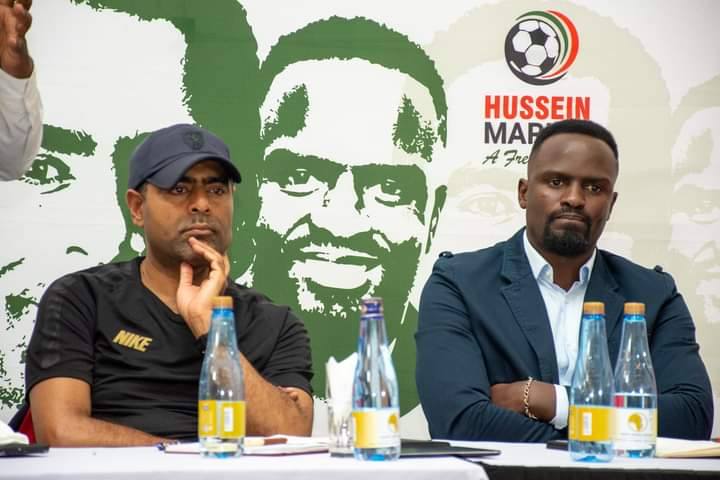
What has unfolded within the Football Kenya Federation in the past two weeks is no longer a routine leadership dispute.
It has evolved into a high-stakes legal and governance battle – one in which the nine NEC members who moved against President Hussein Mohammed now wait for their fate after the current impasse comes to an end.The legal and global football body FIFA remain as the deciding forces on the situation.
A big question abounds. Can the actions taken by the nine withstand constitutional and international scrutiny.Defineltely no with FIFA having already sought, through a letter addressed to FKF, a clear understanding the goings-on at Kandnda House.
The FKF Constitution: Where the Risk Begins
The FKF Constitution is explicit on how power can be exercised – and more importantly, how it cannot.
Any attempt to remove or suspend an elected official must strictly comply with:
Article 41 – which guarantees due process, including the right to be heard and a properly justified motion
Article 42 – which governs the removal of the president
Article 38 – which regulates how NEC meetings are convened
If these thresholds were not met, then the entire process collapses legally.
The implication is immediate and severe:
The suspensions become null and void
The decisions are treated as if they never existed
The nine NEC members are exposed to disciplinary action under Article 68, including suspension, removal, or outright expulsion from football
This is the first layer of risk: they do not just lose the argument – they lose their positions.
Due Process: The Turning Point
One of the most critical tests will be whether:
The accused officials were given a fair hearing
Evidence was properly presented and validated
The required voting thresholds were met
If any of these elements fail, the action is deemed unconstitutional.
Under FKF rules, denying due process is not a minor procedural error – it is a serious governance violation.
That opens the door to:
Immediate reversal of their decisions
Formal proceedings before FKF judicial bodies
Individual liability for misconduct under Article 14, which holds officials accountable for actions taken in bad faith or negligence
At that point, the narrative shifts from “leadership contest” to abuse of office.
FIFA Statutes: The Bigger Threat
While the FKF Constitution defines internal legality, the ultimate authority in football governance lies with FIFA.
And FIFA is far less forgiving.
If the nine NEC members are found to have:
Made unsubstantiated allegations
Used misleading or weak evidence
Attempted to remove leadership outside statutory frameworks
They could be in violation of multiple FIFA provisions, including:
Code of Ethics (Articles 13 & 15) – requiring integrity, honesty, and loyalty
Article 22 – prohibiting abuse of position
Article 21 – addressing falsification or misuse of documents
The consequences here escalate quickly:
Multi-year bans from all football-related activity
Removal from office at national level
Permanent exclusion from future football governance
This is not theoretical. FIFA has consistently enforced these provisions globally where governance breaches are proven.
The Institutional Risk: When Individual Actions Trigger National Consequences
There is an even bigger danger.
Under FIFA Statutes Articles 14 and 16, member associations risk sanctions if governance breaks down or statutes are ignored.
If this dispute is interpreted as:
A breakdown of constitutional order
Emergence of parallel authority structures
Or systemic disregard for governance rules
Then Kenya itself could face:
Direct FIFA intervention
Installation of a normalization committee
Or, in the worst case, international suspension
This would affect:
National teams
Clubs in continental competitions
Sponsorship and commercial agreements
In effect, the actions of nine individuals could cascade into nationwide football paralysis.
The Personal Stakes: Why There Is No Middle Ground
For the nine NEC members, the stakes are uniquely high because of how the situation is structured.
If their case succeeds:
Their actions are legitimized
Their authority is reinforced
Their leadership position becomes defensible
But if it fails:
They lose their positions
They face disciplinary sanctions
They risk long-term or permanent exclusion from football
They carry reputational damage that extends beyond FKF
The views expressed here are not representative of KBC Digital sports.
The post Opinion: What next for 9 FKF NEC members appeared first on KBC Digital.
kbc