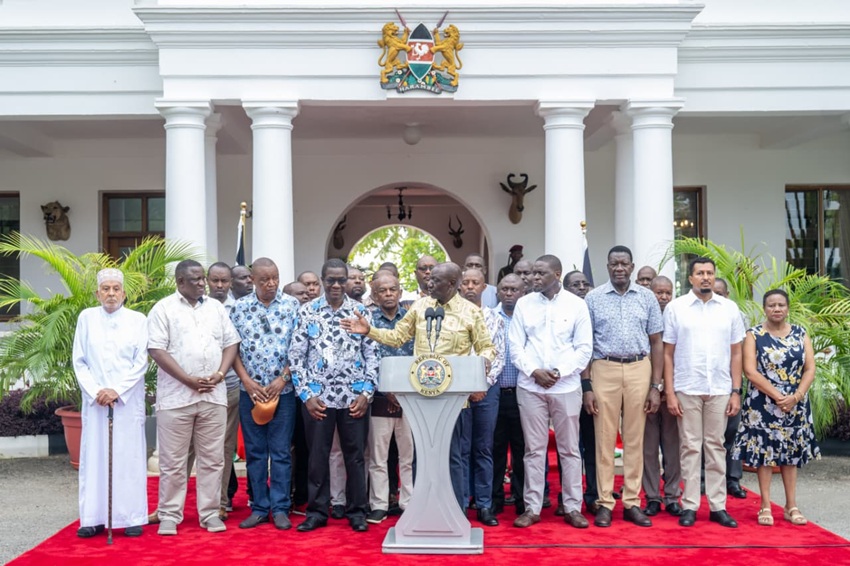
Remarks by his Excellency Hon. William Samoei Ruto, PHD, C.G.H., president of the republic of Kenya and Commander-in-Chief of the defence forces, on the global and national fuel crisis and its impact on Kenya, following a meeting with transport sector stakeholders
Fellow Citizens,
- Over the past few weeks, many families, businesses, farmers, and transport operators have felt the pain of rising fuel prices. I fully understand the frustration and the burden this has placed on households and on the cost of living across our country.
- As your President, I want to speak to you honestly and directly about why this is happening, what the Government is doing, and why we must face this challenge together as one nation.
- The truth is this: Kenya is facing the effects of a global fuel crisis caused by the ongoing conflict in the Middle East. This is not a
crisis affecting Kenya alone. Countries across Africa, Europe, Asia, and the Americas are all struggling with rising fuel prices,
fuel shortages, and disruptions in supply. - Since the conflict involving Iran escalated on 28th February 2026, the Strait of Hormuz, one of the world’s most important
oil supply routes, through which nearly one-fifth of global oil passes every day, has experienced major disruption. This has
created one of the largest global oil supply shocks in modern history. - Within just weeks, global fuel prices rose sharply, with prices increasing by 54.4 per cent for Super Petrol, 118.5 per cent for
Diesel, and 126.4 percent for Kerosene. - These increases directly affected the landed cost of fuel imported into Kenya and ultimately impacted pump prices across the
country. - The World Bank now projects that global energy prices will rise by 24 per cent in 2026 alone, while the International Energy
Agency has warned that the global market may remain undersupplied until late 2026 or beyond. - Fellow Citizens, This is not a Kenyan problem alone. Around the world, governments are introducing emergency measures to manage rising fuel costs, supply disruptions, and pressure on the cost of living. Some countries are now experiencing actual fuel
shortages and rationing. Others have encouraged citizens to work from home in order to reduce fuel consumption, while some
have reduced working days. - Our priority as a government has therefore been twofold: first, to ensure that Kenya continues receiving stable fuel supplies
across the country; and second, to cushion Kenyans as much as possible from the full impact of this global crisis. - Kenya imports nearly all its fuel from the Gulf region. Therefore, when global oil prices rise, the impact inevitably reaches us here at home.
- The current fuel prices reflect that global reality. We recognise that these increases are painful and carry serious consequences
for transport costs, food production, business operations, and the overall cost of living. - I know that for many Kenyans, rising fuel prices are not just numbers at the pump; they affect everyday life. They mean
higher matatu fares, a farmer paying more to transport produce to market, a boda boda rider worried about earnings, a parent
struggling to stretch the family budget, and a business fighting to remain afloat while protecting jobs. - The Government of Kenya has not stood by. We have undertaken several consequential interventions.
- First, through forward planning using the Petroleum Development Fund, we have built strategic financial reserves to
help stabilise the market during times such as these, without disrupting the broader economy as happened in the past. - To cushion consumers from the sharp rise in global oil prices, the Government has used the Petroleum Development Fund to
stabilise fuel prices. - In the last two pricing cycles alone, April–May and May–June 2026, the Government utilised Ksh 13.74 billion to cushion
consumers. - Secondly, working with Parliament, we have reduced VAT on petroleum products from 16 per cent to 8 per cent, foregoing
Ksh 14.43 billion in tax revenue in order to reduce pressure on Kenyan families and businesses. - In the April–May 2026 pricing cycle, the Government utilised Ksh 6.04 billion in fuel stabilisation and also forewent Ksh 6.41 billion in VAT revenue. In total, the Government spent Ksh 12.45 billion on stabilisation during that cycle.
- Because of this intervention, Super Petrol prices were reduced by Ksh 19.67 per litre, Diesel by Ksh 40.25 per litre, and
Kerosene by Ksh 115.03 per litre. - Similarly, during the May–June 2026 pricing cycle, the Government utilised another Ksh 7.7 billion for stabilisation and
forewent Ksh 8.02 billion in VAT revenue. In total, during the current cycle the Government has spent Ksh 15.72 billion on
stabilisation. - As a result, Super Petrol prices were reduced by Ksh 15.87 per litre, Diesel by Ksh 44.89 per litre, and Kerosene by Ksh 78.62
per litre. - Without Government intervention during this cycle, Super Petrol would today have retailed at Ksh 230.12 per litre instead of Ksh 214.25; Diesel would have retailed at KSh 277.75 instead of Ksh 232.86; and Kerosene would have retailed at KSh 270.00 instead of Ksh 191.38.
- Taken together, across the April–May and May–June 2026 pricing cycles, the Government has committed a total of Ksh
28.19 billion in fuel price support through direct stabilisation measures and tax relief interventions. - These interventions have protected millions of Kenyans from even more severe economic hardship.
- I have directed that the cost of diesel be further reduced by Ksh 10 in the June–July cycle to help stabilise pump prices and
provide additional relief to consumers. - Fellow Citizens, Thirdly, through the Government-to-Government (G-to-G) fuel framework, we have secured guaranteed fuel supplies despite global supply chain disruptions, ensuring uninterrupted fuel availability across the country. The arrangement has also stabilised fuel pricing compared to the old spot-market system, where prices fluctuated sharply every month.
- Before the arrangement was introduced in 2023, oil importers faced intense pressure to secure US dollars within short
timelines, driving rapid depreciation of the Kenya Shilling and threatening fuel supply stability. By easing pressure on foreign
exchange demand and ensuring predictable supply terms, the framework has protected the economy during the crisis; without
it, the country’s situation would be far worse today. - I know there are those trying to turn this global crisis into politics; people seeking to exploit public pain for political gain,
making reckless claims, and pretending there are easy solutions. But leadership requires honesty, not political opportunism or
playing populist politics. - The reality is that no country can completely escape a global oil shock of this magnitude.
- Even advanced economies with far greater financial resources than Kenya are facing similar challenges.
- There are those asking Government to remove all taxes and levies on fuel immediately. But we must ask ourselves honestly:
if we stop collecting this revenue entirely, what public services shall we stop funding? - Do we go back to the spectacle of stalled road projects that had become a hallmark across the country? Do we stop the fertiliser
subsidy programme that is enhancing food security? Do we cut the security budget that helps us secure our borders, combat
criminal gangs, and protect citizens, including women and children? Surely our hospitals and schools must continue to
function and be funded. These are not simple decisions. - Leadership requires us to make responsible decisions not only for today, but also for the long-term stability of our country.
Because we do not know how long this crisis will continue, or whether prices may rise even further in the months ahead, we
must act with care, responsibility, and sustainability in mind.
Fellow Citizens, - Every nation facing this crisis is being forced to make sacrifices. Kenya, too, is making sacrifices, but they must be fair,
responsible, and sustainable. - Our responsibility as Government is to solve today’s problems without creating a bigger crisis tomorrow. Our duty is to protect
Kenyan families today, while ensuring the long-term stability of our economy. - That is why Government continues to review every possible measure to reduce pressure on citizens while safeguarding
economic stability. - We are engaging stakeholders across the transport sector, agriculture, industry, and the business community to develop
practical interventions aimed at reducing the impact on livelihoods and economic activity. - This crisis is also a reminder that Kenya must never remain permanently vulnerable to external oil shocks and conflicts
happening thousands of kilometres away from our borders. Therefore, the Government of Kenya, working together with our
East African partner states and the private sector, is determined to bring into production our oil resources in Turkana and across the region, alongside the development of a regional refinery to reduce our vulnerability to disruptions beyond our control. - Equally, we are accelerating investments in renewable energy, electric mobility, modern public transport, and energy security
infrastructure so that future generations of Kenyans are less exposed to global fuel instability. We must embrace electric
vehicles, and as a first step, the Government has already ordered 3,000 electric vehicles through the Ministry of Interior for use by our security and administration officials. - I am also making a declaration that the first 100,000 electric vehicles to be imported into Kenya, whether for public service or
private use, will be duty-free, even as we continue to court investments from electric vehicle manufacturing companies to
establish production facilities in Kenya. - This is not only about overcoming the current crisis, but also about building a more self-reliant, resilient, and economically
secure Kenya for generations to come. - I, however, wish to assure the country that there is no fuel shortage in Kenya. Through the Government-to-Government
framework, under which international oil suppliers are contractually obligated to maintain consistent supply, the
Government is taking all necessary measures to ensure continued, uninterrupted supply and stability in the market. - Fellow Citizens, This situation is not permanent. We have overcome many challenges before, including droughts, floods, terrorism, the COVID-19 pandemic, and global economic shocks. Each time, we prevailed because we stood together as one people.
- I therefore ask all Kenyans to remain calm, patient, and united. To every mother worried about tomorrow’s food prices, every
worker wondering how they will afford transport to work, every trader struggling to keep a small business alive, and every young
person anxious about the future, I want you to know that your Government sees your struggle and stands with you. - To our transport operators, drivers, and logistics workers, we hear your concerns, we respect the important role you play in
keeping our economy moving, and we will continue engaging you to find practical solutions. No Kenyan should feel abandoned
in this moment. - And so, after extensive consultations with stakeholders across the transport sector, a number of critical concerns and proposals
were raised regarding livelihoods, operations, and the sustainability of the industry. Consequently, the Government has
agreed on the following measures:
a. The Ministry of Transport will engage financial institutions and banking partners to provide a platform for transport
operators to address the financial challenges arising from the current crisis, including the possibility of temporary
relief on lending terms within the sector.
- The Ministry of Transport will work together with the Insurance Regulatory Authority to engage stakeholders and
address concerns relating to insurance claims affecting public transport operators. - I have further directed that an immediate review of both the Insurance Act and the Auctioneers Act be undertaken
and concluded within the next three months in order to establish a more responsive and fairer framework for players within the sector.
d. The Ministry of Transport, through the National Transport and Safety Authority (NTSA), will engage transport network companies and drivers operating under digital taxi platforms with a view to implementing regulations on a minimum taxi fare and resolving the long-running disputes affecting the ride-hailing sector. - e. Recognising the important role of creativity and self expression within our transport culture, I have directed
NTSA to facilitate an enabling environment for matatu operators to continue utilising artwork and graffiti on their
vehicles in a manner that upholds safety and respect for other road users. - f. The Government will continue engaging stakeholders across the transport sector to develop practical and
sustainable solutions that protect livelihoods and support economic activity. - 48. I therefore ask all Kenyans to remain calm, patient, and united. Let us reject division, fear, and misinformation. While every
citizen has a right to express their concerns, collectively, we must reject hooliganism and all forms of violence that lead to the loss of lives, disrupt livelihoods, and undermine our economy. Let us use fuel responsibly, support one another and protect our
economy during this period. - 49. We will continue keeping the nation informed and doing everything possible to protect Kenyan families, businesses, and
jobs. We must confront this challenge in the same spirit of unity, resilience and national resolve that has carried Kenya through
difficult moments before. - 50. This crisis was not created by Kenya, but together, we shall overcome it.
May God bless you, and may God bless the Republic of Kenya.
The post Full Speech: Ruto speaks on the global and national fuel crisis appeared first on KBC Digital.
kbc