NAIROBI, Kenya, Mar 21 — It is not uncommon for teachers to reshuffle arrangements during lessons moving some pupils closer to the front, not for discipline, but so they can see the board more clearly.
What often appears at first to be a matter of attention or engagement is, in many cases, something else entirely.
Across Kenya, as is the case across the globe, cases of childhood myopia are rising, driven less by genetics than by how children now live: indoors, on screens, and with limited exposure to natural light.
A meta-analysis published in JAMA Network Open has linked increased daily screen time to a higher risk of developing myopia, reinforcing concerns about prolonged device use among children.
Globally, the scale is significant: research in the British Journal of Ophthalmology projects that more than 740 million children and adolescents could be affected by myopia by 2050—a steep increase largely attributed to environmental and behavioural changes.
In Kenya, the trend is already visible—and uneven. A 2024 study in the African Journal of Empirical Research found that myopia prevalence among children varies sharply by setting.
In urban areas such as Nairobi, rates were recorded as high as 15.6 per cent, compared to just 1.7 per cent in rural Makueni County.
Studies attribute the gap largely to lifestyle differences: more screen exposure, more near-work activities such as reading and device use, and less time spent outdoors.
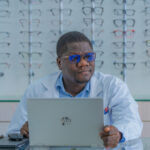
For optometrist Jacob Odongo, the shift is evident in daily practice.
“This is the most active stage of eye development. If something goes wrong here, it can have lifelong effects,” he says, referring to children under six, citing his practice experience at Omega Opticians in Nairobi.
He notes a growing number of early-onset cases—some requiring unusually strong prescriptions.
“You find a child at six years already wearing minus four or minus five,” he says. “That used to be rare outside genetic causes.”

Researchers increasingly point to a combination of prolonged near work and reduced outdoor exposure as key drivers.
When children spend extended periods focusing on close objects—screens, books, tablets—the eye adapts over time. Without the balancing effect of looking at distant objects, that adaptation can become permanent.
“Indoors, the eye is constantly working at close range,” says Odongo. “Over time, it adjusts to that environment.”
Related: Blurred lines: The hidden toll of screen time on our eyes
By contrast, time outdoors appears to play a protective role. Studies indexed by the US National Institutes of Health suggest that increased exposure to natural light can slow the progression of myopia in children.
In classrooms and homes, early symptoms can be subtle. Children who sit too close to screens, struggle to see the board, lose interest in distant objects or show reduced attention span may already be experiencing vision problems.
Research published in BMC Ophthalmology indicates that a notable proportion of children may require vision correction before the age of six—underscoring the importance of early screening. Yet diagnosis is often delayed.
“Some parents think a child is too young for glasses,” Odongo says. “But delaying care allows the condition to worsen.”
The implications extend beyond difficulty seeing the board. Studies link high myopia to increased risks of serious eye conditions later in life, including retinal complications and glaucoma—raising concerns about a future burden of avoidable visual impairment.
In Kenya, that burden is already taking shape: the 2024 study estimates that uncorrected refractive error—primarily myopia—accounts for about 62 per cent of visual impairment cases among children.
The World Health Organization identifies uncorrected refractive errors as a leading cause of visual impairment globally, with children increasingly affected as lifestyles shift.
Access to care remains uneven, with cost emerging as a major barrier. In Kenya, a basic eye test typically costs between Sh1,000 and Sh2,000 at smaller clinics, while comprehensive examinations range from Sh2,000 to Sh3,500.
Specialist paediatric assessments can cost up to Sh5,000. Corrective eyewear adds to the burden with basic glasses starting from around Sh1,700, and well beyond Sh10,00 for durable frames and specialised lenses.
For many families, the unaffordable cost means postponing care—often until the problem becomes more severe and harder to correct.
The transition to the Social Health Authority promises expanded access to primary eye care, including screenings and basic corrective lenses but coverage gaps persist, particularly for specialised paediatric services and higher-quality lenses, leaving many households reliant on out-of-pocket spending.
Experts say the solutions, while simple in principle, require consistent action: more time outdoors, reduced screen exposure, and earlier eye testing.
Even modest increases in outdoor activity can make a measurable difference, particularly during early childhood when the eye is still developing.
“The environment we are raising children in today,” Odongo says, “is shaping how their eyes develop.”
For a generation growing up between screens and classrooms, the unbalanced shift to confined indoor spaces may only become fully visible years later—when what began as a slight blur turns into a lifelong condition.