NAIROBI, Kenya, Mar 22 — At dusk along the Nairobi–Mombasa A109 Road, traffic thickens as long-haul trucks and passenger vehicles stream out of Nairobi towards the coast, while others make the final stretch into the capital.
Headlights flicker on one by one as daylight fades. For some drivers, the road ahead sharpens into focus. For others, it begins to dissolve.
But inside some vehicles, the transition is far less certain. Lane markings fade, distances flatten, and shapes blur at the edges.
A truck that seems comfortably ahead suddenly feels too close. The driver leans forward, squinting, trying to force clarity out of the half-light—never fully certain of what he is seeing.
It is in these moments, eye specialists warn, that a largely invisible danger begins to take hold.
Uncorrected vision among drivers is emerging as a hidden but potentially deadly factor in Kenya’s rising road fatalities, with gaps in screening and enforcement allowing motorists with impaired eyesight to remain behind the wheel.
For James Mwangolo, a 34-year-old delivery driver who frequently travels the Nairobi–Mombasa corridor, the problem revealed itself gradually.
“At first it was just at night,” he says. “Lights looked bigger, scattered. I thought it was normal. Then I started misjudging how far cars were.”
He recalls a near miss outside Athi River when he braked too late, miscalculating the distance between his vehicle and a slowing lorry.
“I had been driving like that for years,” he says. “You don’t realise how bad it is until something almost happens.”
Along sections of the highway, particularly on inclines, the risks are compounded by driving behaviour.
Compromised eyesight
Bus drivers, often under pressure to keep to tight schedules, sometimes veer into climbing lanes or attempt risky overtaking manoeuvres, placing them on a direct collision course with oncoming traffic, particularly when visibility is already compromised. In these split-second moments, the ability to accurately judge distance and speed is not just important—it is critical to avoiding disaster.
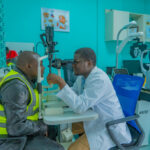
Optometrist Jacob Odongo of Omega Opticians in Nairobi says such cases are far from isolated.

A significant number of drivers, he warns, may be operating vehicles with compromised eyesight—often without diagnosis or corrective lenses—undermining road safety efforts that have largely focused on speeding, alcohol use and infrastructure.
Related: Blurred lines: The hidden toll of screen time on our eyes
Related: Blurred lines: Indoor living, screen time and the growing risk of childhood myopia
In one instance, Odongo examined a driver with a minus 6 prescription—indicative of severe short-sightedness—who had been driving for six years without glasses.
“That is someone who has been on the road for six years without proper vision,” he says. “How do you think they’ve been managing?”
Driving relies on precise visual processing: judging distance, detecting motion and responding to hazards in real time.
When conditions such as myopia or astigmatism go uncorrected, depth perception weakens, peripheral awareness narrows and reaction times slow—subtle impairments that can have catastrophic consequences at speed.
The risks intensify after dark. Glare from oncoming headlights can scatter across the retina, creating halos and starbursts that obscure objects and distort positioning.
“You find someone cannot tell whether a vehicle is on the left or right because of glare,” Odongo says. “That is extremely dangerous.”
Fatla night crashes
Data from the National Transport and Safety Authority (NTSA) underscores the broader danger associated with reduced visibility.
Roughly two-thirds of fatal crashes in the country occur after dark, with a significant concentration in the early evening hours when visibility drops but traffic volumes remain high.
The authority has repeatedly flagged night travel, particularly among Public Service Vehicles (PSVs), as a high-risk period linked to severe crashes. The agency has at times imposed restrictions on night-time travel to curb fatalities.
In high-risk sections such as the Tsavo Corridor along the Nairobi–Mombasa highway, authorities have in recent years installed black spot warning signs following repeated fatal accidents.
The signage is intended to alert drivers to danger zones but its effectiveness ultimately depends on a driver’s ability to see, interpret and react in time.
NTSA figures show 5,009 fatalities were recorded in 2025, a 3.4 per cent increase from the previous year, with road crashes costing the economy an estimated five per cent of GDP—about Sh450 billion annually.
While there is no comprehensive national data directly linking vision impairment to crashes, specialists argue that even a marginal contribution from undiagnosed eyesight problems could translate into hundreds of preventable deaths each year.
Early 2026 figures suggest the trend is persisting, with dozens of fatalities recorded within the first weeks of the year alone.
In January, the NTSA introduced free eye screening for drivers in Nairobi, targeting both private and commercial motorists.
Weak enfrocement
“This programme is part of our broader road safety strategy. Safe driving begins with the driver’s ability to see clearly,” the agency said, signalling plans to expand the initiative.
But enforcement gaps remain a critical weakness.
NTSA does not consistently require periodic vision testing tied to licence renewal, and lacks a centralised mechanism to verify results from eye examinations.
In practice, this creates loopholes through which drivers with impaired vision can continue operating vehicles unchecked.
In more tightly regulated jurisdictions such as the United Kingdom, drivers must meet clearly defined vision standards, including the ability to read a number plate from 20 metres and a minimum visual acuity threshold.
Those who fail to meet the requirements risk losing their licences, while motorists are legally required to declare any condition that could impair their driving.
Odongo argues that Kenya needs similarly enforceable measures: mandatory eye tests conducted through certified facilities, digitally linked to licensing systems, and strict compliance requirements for drivers prescribed corrective lenses.
“If a driver has been certified to drive with spectacles and is found without them, that should be a violation,” he says.
Cost and awareness may also play a role. Routine eye tests remain out of reach for some drivers, while others delay seeking care due to stigma or the assumption that declining vision is a normal part of ageing.
Even among those prescribed glasses, compliance is inconsistent. Some drivers avoid wearing them due to discomfort while others simply underestimate the risk.
For Mwangolo, the change was immediate once he began using corrective lenses.
“The road feels different,” he says. “You can judge distance. You react earlier. You’re not guessing.”
Night driving on the Nairobi–Mombasa A109 Road reflects a broader reality across Kenya’s highways. As darkness falls, headlights multiply into a steady stream of light.
For drivers with clear vision, the road remains steady and readable. For others, it breaks into glare and shadow—where judgement falters and reactions come a fraction too late.
On roads where danger is often measured in speed or alcohol, one of the most overlooked threats may be far simpler—and far harder to detect: what drivers cannot see.