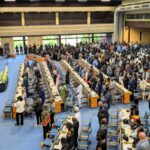
NAIROBI, Kenya, Apr 7 — Solemn songs, candlelight and a minute of silence marked the 32nd anniversary of the 1994 Genocide against the Tutsi at the United Nations Office at Nairobi on Tuesday.
Hundreds of participants, including members of the Rwandan community in Kenya, government officials, diplomats and representatives of international organisations gathered at the UN complex to honour victims of one of the 20th century’s darkest episodes.
The event, organised by the Rwanda High Commission in Kenya and UN agencies, formed part of the global observance of the International Day of Reflection on the 1994 Genocide against the Tutsi in Rwanda, held annually on April 7.
Rwanda’s High Commissioner to Kenya, Ernest Rwamucyo, said the commemoration remains a vital moment to honour the memory of those killed.
“While 32 years can be perceived as a relatively long, it is a very short period given the sheer magnitude of the tragedy and its devastating impact on the entire fabric of the Rwandan society,” he said.
This year’s theme, “Remember, Unite, Renew,” emphasizes remembrance, unity, and a renewed global commitment to preventing genocide.
“For Rwandans, especially survivors and victims of the 1994 genocide against the Tutsi, the memory is still fresh, the physical and mental scars and trauma still haunt them.”
He noted that Rwanda’s journey of rebuilding “from the ashes” has required resilience and sustained commitment.
The Ambassador noted that the genocide was not a “spontaneous eruption” of violence but a carefully planned and executed campaign.
“It was a carefully orchestrated plan of destruction, built over decades of divisionism, discrimination, and dehumanization,” he said, explaining that Tutsis had faced repeated persecution and exclusion prior to the killings.
Genocide denial
Rwamucyo stated that despite progress in reconciliation and nation-building following the end of the genocide by the Rwanda Patriotic Front, challenges persist, including genocide denial and hate speech.
The envoy also raised concern over violence targeting some Tutsi communities including the Banyamulenge in parts of the Democratic Republic of Congo, warning that ethnic hatred remains a regional threat.
He appealed to the international community to act before its too late.
“We must be clear: silence in the face of such warning signs is complicity. We have seen before where denial and indifference can lead,” he said.
“We cannot afford, as an international community, to repeat the mistakes of 1994.”
Rwamucyo called for stronger international cooperation to bring genocide fugitives to justice, and urged governments and institutions to strengthen laws against hate speech and genocide denial, as well as expand genocide education.
The commemoration included exhibitions detailing how the genocide was conceived, planned and carried out, offering participants deeper insight into the events of 1994 and their lasting impact.
Attendees lit candles in memory of the more than 800,000 people killed during the genocide, which unfolded over approximately 100 days.

A minute of silence followed, as the crowd stood in quiet tribute.
In a deeply emotional testimony, Serge Rwigamba, a survivor recounted narrowly escaping death multiple times.
“I was selected five times to be murdered. I worried about my mum and my sisters, but we somehow survived and we are still here,” he said, describing how he survived after another victim was chosen in his place.
He added that at least 315 members of his family, either direct or extended, were killed during the genocide.
His account underscored the scale of personal and collective loss that continues to shape Rwanda’s history and its path toward healing.
In a message delivered by UN Under-Secretary-General and Director-General of the UN Office at Nairobi, Zainab Hawa Bangura, UN Secretary-General António Guterres called on the world to reject hatred and act decisively to prevent future atrocities.
“It’s not enough to remember the dead. We must learn from past failures and protect the living – by rejecting hatred, inflammatory rhetoric and incitement to violence; by investing in the social fabric to deepen community resilience; and by strengthening institutions that help prevent mass atrocities,” Guterres said.
Genocide Convention
He called on all countries to urgently become parties to the Genocide Convention without and to implement it fully.
“Let this day reaffirm our commitment to remember, to listen, and to act. With history as our guide, and the prevention of genocide as our goal.”
Kenya was represented by Ambassador Dennis Mburu of the Ministry of Foreign and Diaspora Affairs, who conveyed the country’s solidarity with Rwanda and reaffirmed the importance of remembrance and prevention.
Speaking on behalf of foreign Affairs PS Korir Sing’Oei, Mburu said, “the tragedy of 1994 was not Rwanda’s alone. It was a failure of humanity.”
“We acknowledge the profound impact of the genocide on the Republic of Rwanda as well as the African Continent and globally. We must never lose sight of the devastating consequences of hatred, intolerance, and the resultant human rights abuses ,” he said.
The United Nations formally designated April 7 as a day of remembrance, refining its title in 2018 to specifically recognize the genocide against the Tutsi.