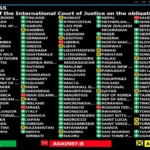
NAIROBI, Kenya, May 21 — The United Nations General Assembly has adopted a landmark resolution welcoming the advisory opinion of the International Court of Justice (ICJ) on States’ legal obligations regarding climate change, with 141 countries — including Kenya — voting in favour.
The resolution, spearheaded by Vanuatu alongside several other nations, passed after intense negotiations and multiple proposed amendments, securing 141 votes in favour, eight against and 28 abstentions.
Countries that voted against the resolution were the United States, Russia, Belarus, Iran, Israel, Liberia, Saudi Arabia and Yemen.

The vote follows a landmark July 2025 advisory opinion by the ICJ, the UN’s principal judicial body, which found that States have an obligation under international law to protect the environment from greenhouse gas emissions.
The Court further stated that countries breaching these obligations could be held legally responsible and may be required to halt the wrongful conduct, guarantee non-repetition and provide reparations depending on the circumstances.
Although ICJ advisory opinions are not legally binding, they carry significant legal and moral authority and are widely regarded as influential in shaping and clarifying international law.
UN Secretary-General António Guterres hailed the General Assembly’s adoption of the resolution as a major affirmation that climate action is a legal obligation rather than merely a political choice.
“The world’s highest court has spoken. Today, the General Assembly has answered,” Guterres said after the vote.
‘Powerful affirmation of international law’
He described the resolution as “a powerful affirmation of international law, climate justice, science and the responsibility of states to protect people from the escalating climate crisis.”
“Those least responsible for climate change are paying the highest price. That injustice must end,” he added.
The resolution calls on all UN Member States to take all possible measures to prevent significant damage to the climate and environment, including limiting emissions generated within their territories and fulfilling commitments under the Paris Agreement.
It also urges governments to cooperate in good faith and coordinate international efforts to address climate change while ensuring climate policies safeguard fundamental rights, including the rights to life, health and an adequate standard of living.
Guterres said the international target of limiting global warming to 1.5 degrees Celsius above pre-industrial levels remains achievable.
US opposition
However, the resolution faced strong opposition from the United States, which argued that the ICJ opinion overstepped its mandate and imposed obligations not agreed upon by Member States.
Speaking before the vote, US Deputy Representative to the UN Tammy Bruce said Washington maintained “serious legal and policy concerns” regarding both the ICJ advisory opinion and the General Assembly resolution.
Bruce argued that the advisory opinion was non-binding and criticised the resolution for portraying the Court’s conclusions as enforceable obligations on States.
“The resolution is highly problematic in calling on States to comply with so-called ‘obligations’ that are based on non-binding conclusions of the Court on which UN Member States’ views diverge,” she said.
The United States also objected to provisions referencing fossil fuel transitions and raised concerns that the resolution could duplicate or interfere with existing negotiations under the United Nations Framework Convention on Climate Change process.
Washington further opposed a provision requesting the UN Secretary-General to prepare a report on advancing compliance with the ICJ advisory opinion, arguing there was no precedent for such a mandate.
Despite the opposition, the overwhelming support for the resolution was viewed as a major diplomatic victory for climate-vulnerable nations seeking stronger international accountability on climate action and environmental protection.